


Medically Reviewed by Dr. Kristen Scholl, DMD on September 23, 2026
One concern that comes up frequently during dental implant consultations is whether the final restoration will look natural, or whether it will be obvious to others that a tooth was replaced. It is a reasonable question, and the answer has a lot to do with how implant prosthetics are designed and fabricated. The crown or bridge placed on top of an implant is not an off-the-shelf piece. It is made specifically for you, based on detailed measurements and a careful color match to the surrounding teeth.
At Bucks County Smiles in Yardley, Pennsylvania, Dr. David Faust provides dental implant restorations that are fully customized to blend naturally with each patient’s existing teeth. The fabrication process is a meaningful part of why implant restorations look and function as well as they do.
Why Custom Design Matters for Implant Restorations
Every person’s teeth are shaped differently. The width, length, curvature, and color of natural teeth vary from person to person, and even within a single person’s mouth, no two teeth are identical. A stock crown made to generic dimensions would stand out in almost any context.
Custom-fabricated implant crowns are designed to match the shade, translucency, and proportions of the surrounding natural teeth as closely as possible. When done well, the restoration is essentially indistinguishable from the teeth around it, and most patients report that within a few weeks of receiving the final crown, they stop thinking of it as a replacement at all.
What Goes Into Creating a Custom Implant Crown
The customization process begins with detailed impressions or digital scans of your mouth taken during the implant planning and healing stages. These records capture the exact dimensions of the space the crown needs to fill, the height of the surrounding teeth, the alignment of your bite, and the characteristics of the neighboring enamel.
A dental laboratory uses these specifications to fabricate the crown to precise measurements. The color matching process involves comparing your natural tooth shade under controlled lighting and communicating that specification to the ceramicist who builds the restoration. For front teeth, the process is especially detailed because the visual impact of even small variations is greater in that part of the mouth.
Materials Used for Implant Crowns and Prosthetics
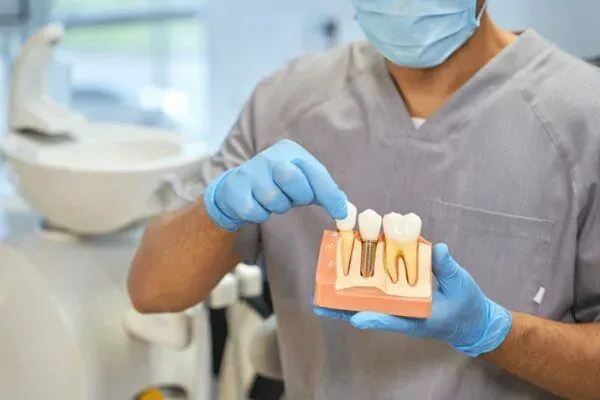
Most implant crowns today are made from zirconia or porcelain-fused-to-metal, both of which can be manufactured to closely replicate natural tooth color and translucency. Zirconia has become particularly common for its combination of durability, biocompatibility, and natural appearance. It is strong enough for use in the back of the mouth where chewing forces are highest, while still providing the aesthetics expected for visible front teeth.
The implant post itself is made from titanium, which has an established long-term safety and compatibility record in bone integration. According to the NIDCR’s Oral Health in America report, advances in implant materials and techniques have significantly expanded the range of patients who can benefit from implant treatment and improved long-term outcomes over the past two decades.
How the Final Prosthesis Is Fitted
Once the implant post has fully integrated with the surrounding jawbone, an impression or digital scan is taken to guide fabrication of the final crown. When the restoration is ready, it is attached to the implant via a connecting piece called an abutment. The fit is carefully checked before the crown is permanently secured, and any minor adjustments to the bite are made at that appointment.
The fitting appointment is also when patients typically see the final result for the first time. Most find that the level of customization built into the process produces a result that meets or exceeds their expectations in terms of appearance and comfort.
How long does it take to get the final crown after implant placement?
After the implant post is placed, a healing period of several months is needed for osseointegration before the final crown can be attached. The exact timing depends on individual healing and whether any preparatory procedures such as bone grafting were involved. Once integration is confirmed, the impression is taken and the crown is typically fabricated and ready for placement within a few weeks.
Will the crown ever need to be replaced?
The implant post itself is designed to be permanent. The crown attached to it may need to be replaced after 10 to 15 years of normal use, depending on how much wear it sustains and how well it is maintained. Good oral hygiene, avoiding habits like teeth grinding, and attending regular professional cleanings all help extend the lifespan of the restoration.
Can the color of the crown be adjusted after it is placed?
Once a crown is fabricated and placed, its shade is fixed. Adjustments would require replacing the crown entirely, which is why the color matching process is done carefully before fabrication. Patients who are considering teeth whitening should do so before their final crown is made so the crown can be matched to the desired shade rather than the current one.
What is the difference between a crown and a bridge for implants?
A crown replaces a single missing tooth and sits on one implant. A bridge replaces two or more adjacent missing teeth and is anchored by implants at either end of the span rather than having a post beneath every replaced tooth. Both crowns and bridges used with implants are custom-fabricated through the same process, and both can be matched precisely to the surrounding natural teeth.
Bucks County Smiles in Yardley, PA
At Bucks County Smiles, every implant restoration is designed and fabricated with the goal of producing a result that looks and functions as close to a natural tooth as possible. Dr. Faust works with each patient throughout the process to make sure the final outcome meets your specific needs and expectations. Learn more about his approach on his provider page.
Ready to take the next step? Contact Bucks County Smiles in Yardley, PA to schedule your dental implant consultation today.
ABOUT THE AUTHOR
Dr. Kristen Scholl, DMD
Clinical Director, Bucks County Smiles, Yardley, PA
Dr. Kristen Scholl earned her Doctor of Dental Medicine degree from the University of Pennsylvania School of Dental Medicine and completed her undergraduate studies at Penn State University’s Schreyer Honors College. Clinical Director of Bucks County Smiles, she is a Premier Invisalign® Provider with advanced training in dental sleep medicine and TMJ treatment, serving patients in Yardley and throughout Bucks County, PA.
